

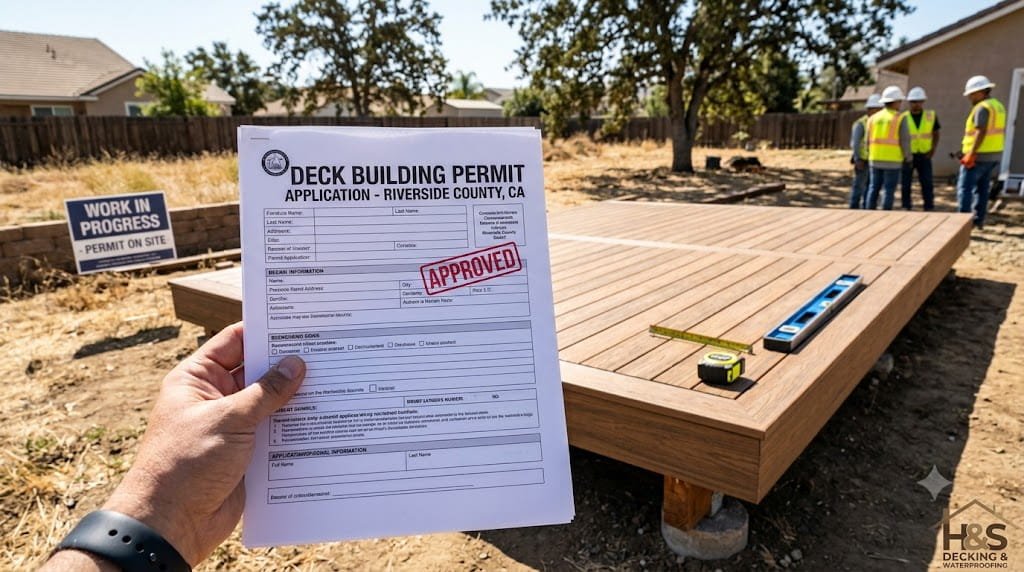
Planning to expand your outdoor living space with a brand-new deck is an exciting milestone for any homeowner. However, before you start buying lumber or hiring contractors, there is a critical legal and safety question you must answer: Do you need a building permit to build a deck in Riverside County?
In most cases, yes, you will need a building permit. Riverside County enforces the strict California Residential Code (Title 24), alongside specific local environmental and wildfire safety ordinances. Building without a permit can result in costly fines, mandatory demolition, and major headaches when you try to sell your home down the road.
This guide will break down the exact permit thresholds, exemptions, and local regulations you need to know for your Riverside County deck project.
When a Deck Permit IS Required in Riverside County
According to the Riverside County Transportation and Land Management Agency (TLMA) and California building standards, you are legally required to obtain a building permit if your proposed deck meets any of the following conditions:
- Attached to the House: If the deck is attached directly to your home via a ledger board, a permit is mandatory regardless of its size or height.
- Elevated Above Grade: Any deck that is more than 30 inches above the ground at any point requires a permit and must include code-compliant guardrails.
- Serves an Egress Door: If the deck serves as a required exit point or doorway from the home, it must be permitted.
- Includes Utilities: Any deck structure that incorporates electrical wiring (e.g., outdoor lighting, outlets), plumbing, or gas lines (for outdoor kitchens or fire pits) requires a permit.
The “Floating Deck” Exception: When You Do Not Need a Permit
Riverside County does offer a specific exemption for low-profile, detached platforms. You do not need a building permit if your project meets all of the following criteria simultaneously:
Permit-Exempt Deck Criteria
- The total area is 200 square feet or less.
- The deck surface is not more than 30 inches above the ground at any point.
- It is completely freestanding/detached from the primary residence.
- It does not serve a required egress door.
- It does not include any plumbing, electrical, or gas utilities.
Note: Even if your deck is exempt from a building permit, you must still adhere to local zoning rules, including property line setbacks.
Crucial Riverside County Local Regulations
Building a deck in Southern California involves unique regional challenges. Riverside County requires strict compliance with several localized safety standards:
Is Your Deck Leaking or Rotting?
1. Wildland-Urban Interface (WUI) Zones
Large portions of Riverside County—including canyon areas, foothills, and communities near the Cleveland National Forest—are designated as high-risk wildfire zones. Decks built in these areas must utilize fire-resistant materials (such as heavy timber, composite decking with a class-A flame-spread rating, or non-combustible underlying structures) and feature ember-resistant under-deck screening.
2. Seismic and Structural Engineering
California’s seismic activity requires decks to withstand lateral loads from ground movement. Structural hardware (such as joist hangers and post caps) must be corrosion-resistant and seismically rated. Footings must extend a minimum of 12 inches below grade, though hillside properties often require deeper, engineered concrete piers.
3. Multi-Family Compliance (SB 326 & SB 721)
If you own an apartment building or manage a condominium HOA in Riverside County, your exterior elevated elements are subject to state compliance laws:
- California SB 721 mandates structural safety inspections every 6 years for multi-family complexes with 3+ units.
- SB 326 mandates inspections every 9 years for condominium associations.
The Riverside County Deck Permitting Process
If your deck requires a permit, the process involves a few structured steps through the PLUS Online portal or in person at a Riverside County TLMA office:
| Step | Phase | What to Expect |
| 1 | Site Plan & Design | Create scaled architectural drawings showing exact dimensions, footings, framing configurations, and distances to property lines (setbacks). |
| 2 | Application Submission | Submit your application, construction plans, and structural calculations to the Riverside County Building & Safety Department. |
| 3 | Plan Review | County officials review the plans for code compliance. This typically takes 1 to 4 weeks depending on the complexity of the project. |
| 4 | Inspections | Once approved, construction can begin. You will need to schedule standard inspections: 1) Footing and formwork (before concrete is poured), 2) Framing, and 3) Final sign-off. |
Avoid the Sales Fluff—Build It Right with H&S Decking
Navigating structural engineering, zoning setbacks, and WUI fire codes can be overwhelming. At H&S Decking & Waterproofing, we are a family-owned, local contractor specializing in code-compliant deck construction, repair, and waterproofing throughout Riverside County. We pull the permits, handle the inspections, and cut zero corners.
Ready to get started on your Canyon Lake or Riverside County property?
Bypass the waiting list and speak directly with a diagnostic technician today.
- Call Us: 951-634-2795
- Visit Us: 31566 Railroad Canyon Rd. Ste. 2 PMB#43, Canyon Lake, CA 92587
- Schedule Online: Click here to request an immediate structural quote or book a same-day inspection layout.
Subject Matter Context
Core Pillar Connection: This technical guide is part of our Codes & Permitting series. For comprehensive execution and guaranteed results in Canyon Lake, review our official protocol: Deck Building & Construction.