
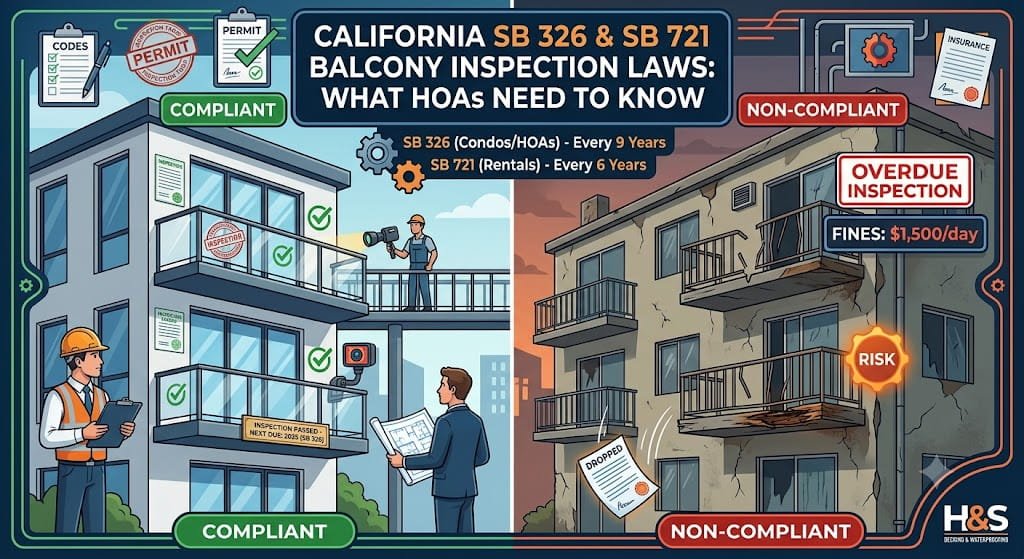
In California, structural safety is no longer a matter of guesswork or deferred maintenance. Following the tragic 2015 balcony collapse in Berkeley, the state legislature passed two landmark pieces of legislation—Senate Bill 326 (SB 326) and Senate Bill 721 (SB 721).
These “balcony inspection laws” mandate strict, recurring safety checks on Exterior Elevated Elements (EEEs). Because the initial statutory deadlines for both bills have officially passed, non-compliant property owners and Homeowners Associations (HOAs) face steep daily fines, severe insurance complications, and massive liability exposure.
Here is a definitive guide to what these laws mean for your property in 2026, how the two bills differ, and what steps you must take next.
What is an “Exterior Elevated Element” (EEE)?
The regulations apply strictly to structures that meet all of the following criteria:
- Height: Any walking surface located more than 6 feet above adjacent grade (ground level).
- Purpose: Designed for human occupancy or use.
- Materials: Supported in whole or in substantial part by wood or wood-based products (this includes hidden wood-framed substructures underneath concrete or tiled finishes).
- Specific Structures: Balconies, decks, porches, exterior stairways, walkways, breezeways, landings, and their associated railings and waterproofing systems.
SB 326 vs. SB 721: Key Differences at a Glance
While both laws aim to prevent structural failures caused by hidden wood rot and water intrusion, they target entirely different ownership structures and carry different compliance protocols.
| Feature | SB 326 (Condos & HOAs) | SB 721 (Multifamily Rentals) |
| Applies To | Condominiums and Common Interest Developments (3+ attached units) | Apartment buildings and multifamily rental properties (3+ units) |
| Responsible Party | HOA Board of Directors | Building / Property Owner |
| Initial Deadline | January 1, 2025 (PASSED) | January 1, 2026 (PASSED) |
| Inspection Cadence | Every 9 years | Every 6 years |
| Who Can Inspect? | Licensed Structural or Civil Engineers, or Licensed Architects only | Architects, Civil/Structural Engineers, Certified Building Inspectors, or Class A, B, or C-5 Contractors (with 5+ years experience) |
| Sampling Scope | Statistically significant sample (95% confidence interval, $\pm5\%$ margin of error) | Minimum 15% of each type of element across the property |
| Financial Integration | Must be integrated directly into the HOA’s Reserve Study | Handled through standard operating/capital expenditure planning |
The Risk of Non-Compliance in 2026
Because the statutory deadlines for both laws are now in the rearview mirror, local building departments are actively enforcing compliance. If your property or HOA has not completed its initial inspection, you face immediate risks:
- Compounding Civil Fines: Local enforcement agencies can assess civil penalties ranging from $100 to $500 per day until the violation is cured.
- Insurance Non-Renewals: Many California property insurance carriers now require proof of an SB 326 or SB 721 inspection report to renew policies. Non-compliance can lead to dropped coverage or skyrocketing premiums.
- Severe Civil Liability: Skipping a statutory safety check constitutes legal negligence. If an uninspected balcony fails or causes injury, individual owners and board members face immense financial liability.
Understanding the Inspection Process
A compliant inspection is designed to be as non-invasive as possible, typically combining a visual assessment with moisture meters, infrared imaging, or borescopes. The inspector evaluates the load-bearing components alongside the waterproofing membranes, flashing, and sealants.
Is Your Deck Leaking or Rotting?
Once finished, the inspector issues a stamped report categorizing the elements into three categories:
- No Action Required: The structure is sound. The report is filed, and you wait for your next 6- or 9-year cycle.
- Non-Emergency Repairs: Structural or waterproofing wear (like dry rot or compromised flashing) is found, but it doesn’t pose an immediate threat. Under SB 721, owners must apply for a repair permit within 120 days and complete the work within 120 days of approval.
- Emergency Conditions: The inspector finds an immediate life-safety hazard. The area must be shut off or shored up immediately, and the local building department must be notified within 15 days.
Important Conflict of Interest Safeguard: To ensure complete transparency and honesty, the state of California strictly regulates that the licensed professional performing your diagnostic inspection should not have any economic affiliation with the contractor performing the subsequent repairs.
Protect Your Investment with H&S Decking & Waterproofing
Whether your HOA needs to execute repairs flagged in a recent SB 326 reserve study, or you are a rental property owner racing to clear an overdue SB 721 requirement, H&S Decking & Waterproofing is your verified local expert.
We specialize in full-scale deck and balcony reconstruction, structural repair, and advanced commercial waterproofing systems designed to keep wood-framed substructures safe from the elements for decades.
Get a Structural Quote Today
Bypass the standard booking waitlist and speak directly with a diagnostic technician.
- Phone: 951-634-2795
- Address: 31566 Railroad Canyon Rd. Ste 2 PMB#43, Canyon Lake, CA 92587
- Schedule an Inspection / Request an Estimate
Disclaimer: This technical guide is part of our Codes & Permitting series. Local jurisdictions may enforce stricter municipal guidelines. Always consult with legal counsel and your structural engineer to verify your specific community requirements.
Subject Matter Context
Core Pillar Connection: This technical guide is part of our Codes & Permitting series. For comprehensive execution and guaranteed results in Canyon Lake, review our official protocol: Deck Building & Construction.