

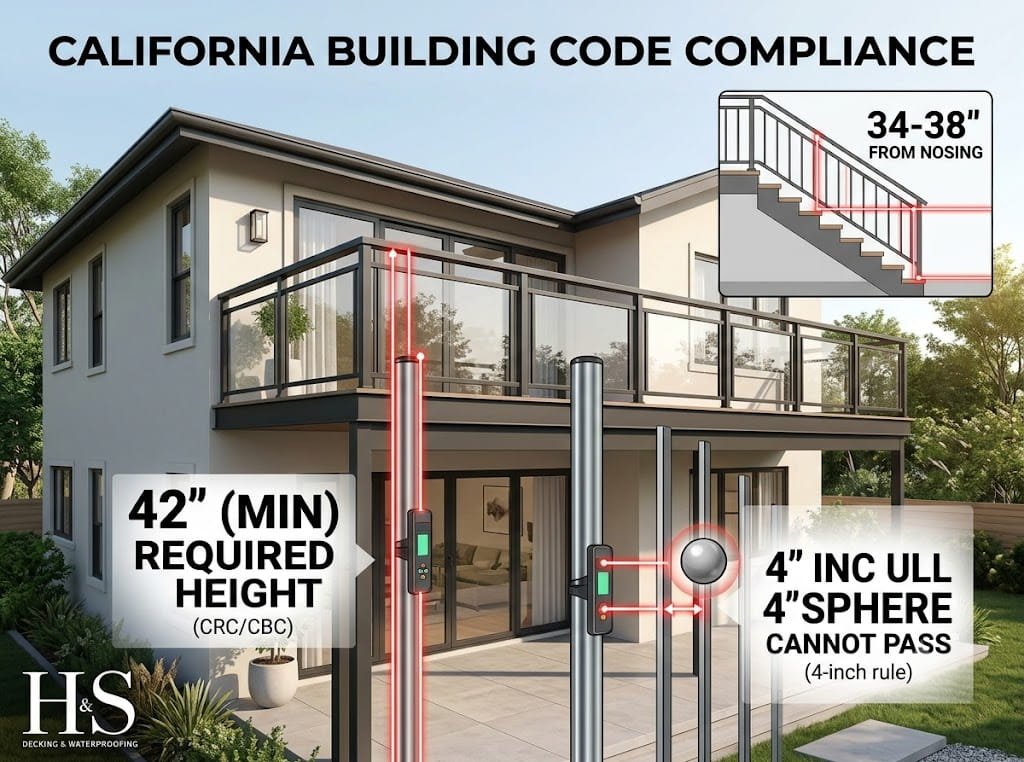
When building or repairing an elevated deck, porch, or balcony in California, understanding the strict mandates of the California Building Code (CBC) and the California Residential Code (CRC) isn’t just about passing inspection—it is a critical matter of structural safety.
With recent state legislation like SB 326 and SB 721 putting a magnifying glass on exterior elevated elements, ensuring your guardrails meet precise legal frameworks is more important than ever.
1. When is a Guardrail Legally Required?
Before diving into height specifications, you must establish if your platform requires a guardrail assembly at all.
- The 30-Inch Rule: Under the California Building Code (CBC), guardrails are legally mandatory along open-sided walking surfaces—including decks, balconies, porches, landings, and ramps—if the walking surface is more than 30 inches above the floor or natural grade below.
- The 36-Inch Horizontal Rule: This height drop is measured anywhere within 36 inches horizontally from the edge of the platform. If the grade drops significantly just outside the edge of your deck, a compliant guard is mandatory.
2. California Railing Height Requirements
While the standard across most of the United States permits a 36-inch residential railing, California enforces stricter rules depending on your property type:
| Application Type | Required Minimum Guardrail Height | Code Basis |
| Single-Family Residential | 42 inches minimum from the adjacent walking surface | California Residential Code (CRC) |
| Multi-Family / Commercial | 42 inches minimum from the finished floor level | California Building Code (CBC) |
| Stair Guards (Open Sides) | 34 to 38 inches measured vertically from the stair nosing | CRC & CBC Alignment |
⚠️ Critical Note: If your railing serves a dual purpose as both a guardrail and a handrail on a set of stairs, the top of the rail must sit strictly between 34 and 38 inches measured vertically from the tread nosing line.
Dispatch Terminals ActiveIs Your Deck Leaking or Rotting?
Don't wait for minor damage to turn into a major collapse. Speak directly with a local deck specialist in Canyon Lake for a fast evaluation.
3. The “4-Inch Sphere” Infill Rule
A guardrail’s height means very little if the infill structure leaves dangerous gaps. To prevent small children from slipping through or becoming trapped, California building standards enforce strict spacing rules for balusters, cables, and glass panels:
- The 4-Inch Rule: Open guards must have intermediate rails, cables, or ornamental patterns spaced closely enough that a 4-inch sphere cannot pass through any gap from the walking surface up to the required height.
- The Stair Exception: For the triangular openings formed by the stair riser, tread, and the bottom element of the guardrail, the spacing is slightly relaxed. Here, the opening must be tight enough that a 6-inch sphere cannot pass through.
4. Structural Load Capacities
Rallings cannot just look sturdy; they must undergo structural verification to resist physical force. According to the California Building Code, guardrail systems must be engineered to withstand the following loads without structural failure:
- Concentrated Load: A single point load of 200 pounds applied to the top rail in any outward or downward direction.
- Linear Load: For commercial applications, guards must be capable of resisting a uniform load of 50 pounds per linear foot applied along the top rail.
Ensure Local Compliance Before You Build
While these codes represent the baseline state standards across California, individual municipalities and local building departments occasionally enforce even stricter local ordinances or structural engineering amendments.
Are you retrofitting an older deck or planning a new balcony construction? Contact our diagnostic technicians today to review your project’s specific code path and verify full local compliance.
Subject Matter Context
Core Pillar Connection: This technical guide is part of our Codes & Permitting series. For comprehensive execution and guaranteed results in Canyon Lake, review our official protocol: Railing Repair & Maintenance.